Hearts for Happiness Campaign
Difficulties and Successes
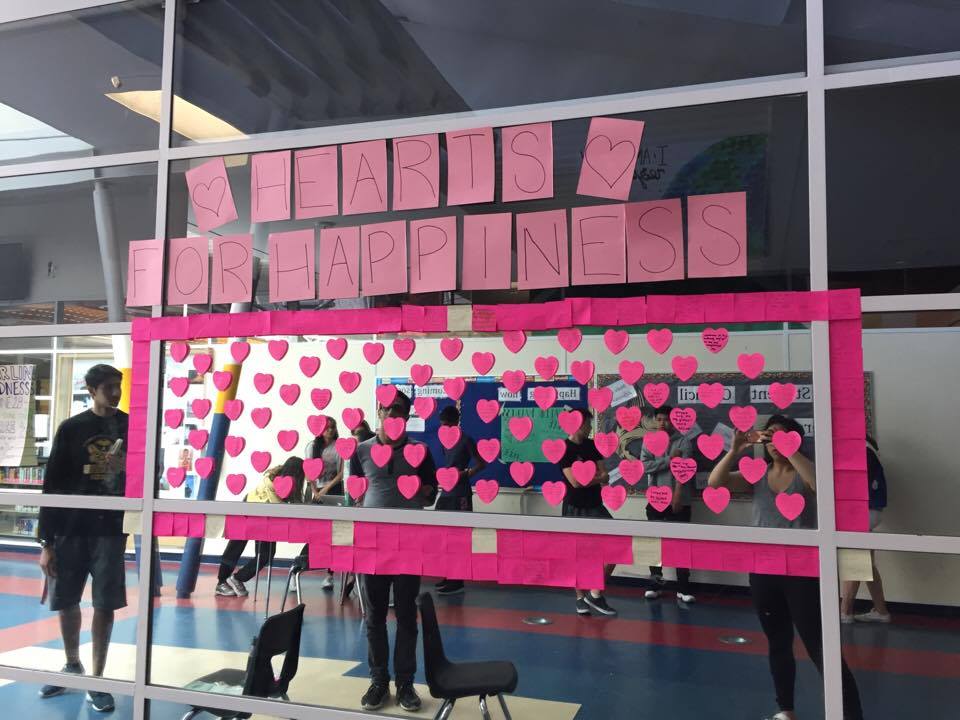
The most challenging part of our action plan was finding a way to reach out to as many students at McNair as possible as we were not as well organized as I wish we were. Had we gone ahead and asked teachers to participate much in advance, we would have most likely had better responses. We did not take in to consideration teacher's schedules as it was the last two weeks of classes. We also ran out of heart-shaped sticky notes (I blame Walmart for not having enough) and had to resort to Hot Pink squares. Although these issues were minor in the overall message of our project, we were still able to communicate the message to multiple classrooms and have students reflect on their experiences.Biases and Assumptions
The topic of bullying comes with many biases and assumptions based on personal experience and media exposure. Bullying has been dramatized for entertainment purposes and sometimes can be over-played, or under-played depending on the situation. It is important that we understand each individual's feelings as opposed to how the majority of people would react in a situation. Bias is also a factor as a person researching bullying may highlight all negative aspects if they were bullied, or try to justify actions if they ever were perpetrators. However, it is important that the rule of "treat others as you wish to be treated" gets used regularly in order to provide a safe, healthy environment for all students, educators, and people in society.The Causes of Bullying and How to Combat It
Bullying is an epidemic that has recently come to the attention of the media as high school students are directing intentional hostility towards individuals or groups for specific reasons. Although bullying is common in institutions for both children and adults, deleterious effects of oppression can be seen in minors as it impacts their academics, extracurriculars, and social lives. In order to correct the social injustice that is bullying, society must recognize the causes of harassment and identify students at-risk of victimization. In doing so, early intervention may prevent abuse as well as lead to a deeper understanding of bullying behaviour and the extent of trauma as a result.Bullying can be defined as “aggressive behaviour intended to harm another, that is repeated over time and involves and power imbalance,” (Hase, et al., 2015, p.608). The idea of a power imbalance enables bullies to seek targets “who are not likely to be defended by peers,” (Wong, et al., 2013, p.279) in order to reduce the loss of affection and support from others. Even though all students are subjected to bullying, major contributing factors include: appearance, sexual orientation, physical or mental impairment, speech or language problems, social isolation, and excessive obedience. These attributes cause “the dislike of others, by not fitting in with other students due to peculiarities or eccentricities, or by misunderstandings that result from poor communication skills,” (Wong, et al., 2013, p.284). However, feelings of insecurity and low self-esteem prevent victims from confronting their attackers as “coming forward...risk[s] further stigmatization by acknowledging that [the target] was the weaker individual in the conflict,” (Donoghue & Raia-Hawryiak, 2016, p.32). In addition the traditional bullying, abuse has spread online in the form of cyberbullying. Cyberbullying serves as an additive harm as it extends beyond the school environment and follows the victim home. The anonymity and unlimited access to victims ultimately makes targeting easier, as less supervision allows a larger audience to witness such behaviour. Despite common misconceptions, it has yet to be proven that cyberbullying is any more or less harmful than traditional bullying, but is still recognized as inappropriate behaviour leading to the belittlement of others.
Another issue relating to relational aggression is classifying what is constituted as joking, teasing, or bullying. The fact that kids interpret people’s actions differently leads to miscommunication either enabling a bully to continue, or wrongfully punishing a student for their actions. The extent of harmful comments and behaviours may differ from each person as “students who acknowledge involvement in aggressive activities have been found less likely to define [verbal and physical abuse] as forms of bullying.” (Donoghue & Raia-Hawryiak, 2016, p.31). They may also be influenced by their social status and individual characteristics, altering their point of view on the issue of bullying. However, “Parents and teachers shouldn’t dismiss what may seem like minor bullying,” (School Bullying Linked to Lower Academic Achievement, 2017, p.55) as “a comprehensive approach that encompasses school officials, students, and their families is needed to prevent bullying among middle school and high school students,” (McKenna et al., 2011, p.470).
In order to end bullying, one must understand why bullies exert such behaviours. The reasons behind harassment can be divided into two subcategories, emotional and instrumental. Emotional, or impulsive, bullying occurs with little or no forethought. These actions are usually for entertainment purposes or the distaste for something in a particular moment. Instrumental bullying is moreso premeditated and done in order to obtain material, gain power, and hold status over someone. Other reasons for bullying may be peer pressure, revenge, or emotional release although “bullying nevertheless has its own rationale and background,” (Wong et al., 2013, p.279). However, bullies are not the only ones to blame as witnesses and bystanders further perpetuate the issue by laughing, watching, and encouraging aggressive behaviour from the sidelines. When no one advocates against a bully’s behaviours, they misread passivity as a sign that others condone and tolerate violence. This enables bullies to continue as it construes their actions as unproblematic and justified, leading to bullies blaming the victim’s own personality for their demeanor.
It is important that bullying in school is addressed as “multiple students have documented the association between substance abuse, poor academic achievement, mental health problems, and bullying,” (McKenna et. al, 2011, p.465). Prevention programs alone have been unsuccessful in changing classroom behaviours despite stories of children being bullied and committing suicide. Although having raised public concern, it is essential that parents, school authorities, and other students take adequate action on the social injustice. In attempt to reduce the amount of bullying in schools, the CDC developed School Health Guidelines to Prevent Unintentional Injuries and Violence. They wish to establish establish a social school environment that promotes safety, prove access to health and mental health services, integrate school, family, and community prevention efforts, as well as provide training to enable staff members to prevent violence effectively. Schools have a central role in “influenc[ing] a school’s whole organization including relations among students, teachers, school staff and families,” (Greco & Zanetti, 2013, p.232) as they have the ability to strengthen the institutional network. Schools have also resorted to punishment, sanctions, and rehabilitation for more serious and persistent bullies that have recurring issues in regards to aggressive behaviours. There has even been pressure for lawmakers to take a stand against bullying by implementing laws that discipline offenders. In addition, non-government organizations have implemented programs to promote well-being and combat anti-social behaviours seen in schools across the globe. By encouraging equality, and recognizing “the effects of micro-level relationships with parents and peers and school connectedness,” (Donoghue & Raia-Hawryiak, 2016, p.31) society is able to prevent bullying as they promote more inclusive behaviour among students. To correct the injustice, one must narrow down differences in perspectives and increase adult-student collaboration to prevent bullying. Analyzing contextual variables and emphasizing the importance of tolerance in the school curriculum may also further prevent bullying-behaviours. That being said, students should take initiative and monitor their own demeanor in consideration of their peers.
Personal Reflection
My belief against bullying stems from personal experiences as both perpetrator, and victim of aggressive behaviour. In elementary school, I was lucky enough to reach a social status where I was accepted by peers which lead to conforming to societal norms. The pressure to act a certain way was a major factor in why I mistreated others. Although I look back and regret my actions, I understand the need to maintain a reputation. After transferring schools in seventh grade, and continuing to high school, I found myself facing different challenges. Being apart of the Mini School program is both a blessing, and a curse. On one hand, I receive opportunities to push myself academically, physically, and emotionally. On the other, I am isolated away from the rest of my graduating class as well as compete against others for outstanding academic results. By being separated from the rest of the grade, it puts a strain on you socially. It’s hard to talk to people who stigmatize the students in the program and call them “try-hards” and “nerds”, but consequently if you aren’t exceeding expectations, you mini school peers deem you unworthy of the program, and therefore judge you for your performance. The things people can say, and do, greatly impact how a person sees him or herself, ultimately, affecting their self-esteem. I chose this project topic because I want to make a difference in the school environment by promoting kindness and positivity as opposed to allowing future students to harass each other for specific reasons. My group’s action plan does not punish those who bully, or attempt to save those who are victims, but instead tries to emphasize the importance of a kind act. By having students reflect on their own experiences, they are able to connect with the cause on a personal level. It is common to see bullying, but it isn’t to recognize the small things that people do which impacts how a person sees themselves. Although belittlement has made me biased against bullies, I advocate against aggressive behaviour as I do not condone the mistreatment of others under any circumstance. One may assume a bully has their own issues, and is taking it out on a victim, however-they do not realize that the feelings of insecurity and doubt they possess transfers to the targets they attack. It is important that we emphasize acceptance, tolerance, and inclusion by taking a stand against bullying in order for all students to feel safe, secure, and welcomed.References
Donoghue, C., & Raia-Hawrylak, A. (2016). Moving beyond the Emphasis on Bullying: A Generalized Approach to Peer Aggression in High School. Children & Schools, 38(1), 30-39.
Greco, D., & Zanetti, C. (2013). PROBLEMS AND SOLUTIONS TOWARD BULLYING AND (PEER) VIOLENCE: EXISTING GOOD PRACTICES. Annales: Series Historia Et Sociologia, 23(2), 229-244.
Hase, C. N., Goldberg, S. B., Smith, D., Stuck, A., & Campain, J. (2015). IMPACTS OF TRADITIONAL BULLYING AND CYBERBULLYING ON THE MENTAL HEALTH OF MIDDLE SCHOOL AND HIGH SCHOOL STUDENTS. Psychology In The Schools, 52(6), 607-609.
School Bullying Linked to Lower Academic Achievement. (2017). Education Digest, 82(8), 53-55.
Wong, C., Cheng, Y., & Chen, L. (2013). Multiple perspectives on the targets and causes of school bullying. Educational Psychology In Practice, 29(3), 278-292.
Annotated Bibliography
Donoghue, C., & Raia-Hawrylak, A. (2016). Moving beyond the Emphasis on Bullying: A Generalized Approach to Peer Aggression in High School. Children & Schools, 38(1), 30-39.
This article discusses the proliferation of bullying cases reported in the media as well as emphasizes the how a person’s personality can affect their definition of bullying. The authors reviewed difficulties in measuring aggression as they found in-school surveys unreliable due to generalized definitions of bullying, and students’ reluctance to admit fault. Although researchers found similarities in aggressive behaviours despite age, they found differences in regards to genders as boys and girls considered different factors when defining bullying. It is relevant to my essay as it emphasizes what is perceived as bullying and connects it to how a person behaves. By comparing a person’s definition of bullying to their demeanor, we are able to understand the extent of what a person deems appropriate or inappropriate.
Greco, D., & Zanetti, C. (2013). PROBLEMS AND SOLUTIONS TOWARD BULLYING AND (PEER) VIOLENCE: EXISTING GOOD PRACTICES. Annales: Series Historia Et Sociologia, 23(2), 229-244.
This paper highlights the importance of preventing bullying and suggests how to reduce peer violence in schools. Authors researched to find the most effective and relevant means of demoting negative behaviours in order to promote kindness and equality amongst students. It is relevant to my research topic as social justices can only be corrected if people take the initiative to implement change. Having a greater understanding of how to resolve the issue of in-school bullying ultimately makes the research and learning worth it as it can lead to people making impactful change.
Hase, C. N., Goldberg, S. B., Smith, D., Stuck, A., & Campain, J. (2015). IMPACTS OF TRADITIONAL BULLYING AND CYBERBULLYING ON THE MENTAL HEALTH OF MIDDLE SCHOOL AND HIGH SCHOOL STUDENTS. Psychology In The Schools, 52(6), 607-609.
Researchers examined the prevalence and overlap of cyber and traditional types of bullying. They found that a majority of students who are victims of cyberbullying also experienced bullying in-person. This is relevant to my topic as it allows me to compare and contrast two different types of bullying as both have consequences. It also enables readers to empathize with people subjected to abuse as victims are unable to escape their bullies due to an online presence and electronic activity. Researchers suggest that traditional and cyber forms of bullying tend to target the same people, yet traditional bullying is more associated with negative psychological outcomes.
McKenna, M., Hawk, E., Mullen, J., & Hertz, M. (2011). Bullying Among Middle School and High School Students--Massachusetts, 2009. MMWR: Morbidity & Mortality Weekly Report, 60(15), 465-471.
Authors discuss a report released by the Massachusetts Department of Public Health and the U.S Centers for Disease Control and Prevention on the topic of bullying and it’s impact of bullies, victims, and non-associated students. Researchers analyze data from a survey taken in 2009 in which they compare and contrast what behaviours separate bullies and victims. It was found that bully-victims have more risk-factors than bullies themselves, and that there are many contributors that are associated with being a bully such as poor mental health, substance abuse, and low academic achievement. This article is related to my essay as it allows the reader to understand the different effects negative actions have on both victims and bullies. It also highlights things that are associated with bullying, ultimately raising awareness that bullying does exist, and that it is more common than one believes.
School Bullying Linked to Lower Academic Achievement. (2017). Education Digest, 82(8), 53-55.
This periodical focuses on research conducted by the American Psychological Association that demonstrates a connection between lower academic achievement and experience with bullying. It highlights the impact of media has on bully and victim stereotypes. The authors argue that the public should be concerned with bullying as it can lead to physical and emotional harm, ultimately affecting a person’s overall well-being and mental health. This article is relevant to my research as it shows the effect bullying has on a person’s confidence, and self-esteem, especially in an environment where academics are concerned.
Wong, C., Cheng, Y., & Chen, L. (2013). Multiple perspectives on the targets and causes of school bullying. Educational Psychology In Practice, 29(3), 278-292.
Wong et. al discuss the importance of different roles when examining bullying. By understanding multiple point of views, one can pinpoint possible causes of bullying, as well as recognize which students are vulnerable targets. These high-risk students are typically atypical or do not follow societal norms, ultimately isolating them from their peers. In the survey assessed by researchers, it was found that bullies target students for reasons including possessing material goods, achieving status, or having fun. It was also found that teachers and students have different opinions on the causes of bullying when asked about blaming victims, justifying bully behaviours, or extent of tolerance for diversity. The topics discussed are relevant to my essay as it demonstrates a distinction between students who experience bullying, or are bullies, and the staff who witness negative behaviours. In order to intervene at an early stage, it is essential that people are able to predict targets of bullying as well as understand why bullies act in a disrespectful manner.
